

Cladonia rangiferina, also known as "reindeer moss," is a species of lichen native to the boreal and arctic regions of the Northern Hemisphere. The name "chrobotek" derives from a Slavic root meaning something rough, coarse to the touch, which perfectly captures the texture of this plant. In the botanical world, lichen holds a special place as a symbiotic organism, combining the characteristics of an alga and a fungus.
Geographical origin of lichen moss
Lichen moss is an organism with a fascinating natural history, whose original environment significantly influenced its unique properties. Let's examine in more detail the origins of this unique lichen and the conditions that shaped its distinctive appearance.
Reindeer moss is native to the temperate and subarctic climate zones of the Northern Hemisphere. Its primary habitats include the Scandinavian countries, Russia, Canada, Alaska, and the northern regions of Europe and Asia.
At Vikingmoss we specialize in sourcing lichen from the cleanest regions of northern Europe, where natural conditions favor the growth of healthy and robust specimens. Our experience shows that Scandinavian lichen is characterized by exceptionally intense color and durability.
It's worth noting that the lichen prefers dry, sunny habitats. It can most often be found in the following locations:
- Pine and spruce forests
- Moors
- Arctic tundra
- Rocky hills
- Sandy soils with low nutrient content
Natural conditions favoring the development of the lichen
Reindeer moss is an organism perfectly adapted to harsh climatic conditions. Its ability to survive in extremely harsh environments is one of the reasons for its remarkable durability, even after stabilization .
In its natural habitat, lichen prefers acidic, nutrient-poor soils. It is a photosynthetic organism that requires access to sunlight, although it tolerates periods of dryness well. Ecological studies indicate that it thrives best in conditions where:
- The average annual temperature is from -5°C to +5°C
- Annual rainfall does not exceed 500-700 mm
- The pH of the substrate is in the range of 4.0-5.5
- There is a large temperature amplitude between day and night
Our research, conducted in collaboration with botanists, confirms that it is these harsh conditions that give the lichen its unique structure and resistance, which it retains even after the stabilization process.
The ecological importance of the lichen in ecosystems
Reindeer moss plays a crucial role in the ecosystems it occurs in. It is a pioneering organism capable of colonizing infertile soils, creating conditions for other plants to thrive.
In the Arctic tundra, lichen is a staple food for reindeer (hence the name "reindeer") and also forms an insulating layer that protects the soil from freezing. According to data from 2023, reindeer populations in northern Scandinavia depend on the availability of lichen for up to 60-70% of their winter diet.
At Vikingmoss we pay special attention to the sustainable sourcing of our lichen. We only work with certified suppliers who adhere to selective collection practices.
The history of the name "chrobotka" - etymology and cultural significance
The name "chrobotek" has a fascinating linguistic and cultural history. Let's delve into the origins of this name and the role this inconspicuous organism has played in various cultures.
Etymology of the word "chrobotek"
The word "chrobotek" comes from a Proto-Slavic root meaning something rough or coarse to the touch. The term has been in use in Polish since at least the 17th century and perfectly captures the nature of this plant.
It is worth noting that in many European languages the names of the lichen refer to its association with reindeer:
- English: “reindeer moss”
- German: “Rentierflechte” (reindeer lichen)
- Swedish: “renlav” (reindeer lichen)
- Finnish: “poronjäkälä” (reindeer lichen)
The Latin species name "Cladonia rangiferina" also refers to reindeer, with "rangifer" meaning reindeer. The scientific classification was introduced by Carl Linnaeus in 1753 in his groundbreaking work "Species Plantarum.".
Our experience at Vikingmoss shows that customers are often surprised to learn that reindeer moss is not a true moss, but a lichen. This botanical curiosity adds an extra touch of charm to the product and provides an interesting educational element when presenting our products.
The cultural significance of the lichen in different communities
For centuries, lichen has played an important role in the cultures of the northern peoples. For the Sami (Lappish) communities, it not only provided an indirect source of food (through reindeer meat) but was also used in folk medicine and rituals.
In traditional Scandinavian medicine, reindeer moss was used as:
- Antipyretic
- A cure for lung diseases
- A remedy for digestive problems
At Vikingmoss we draw inspiration from this rich cultural heritage, combining traditional knowledge with modern stabilization technologies to deliver top-quality products that not only decorate interiors but also carry a fascinating history.
Botanical classification of the reindeer moss – a lichen, not a moss
The common name "lichen moss" can be misleading, as botanically speaking, lichen is not a moss but a lichen. We will now explain this important difference and discuss the unique nature of lichens as symbiotic organisms.
The difference between moss and lichen
Mosses and lichens are two completely different groups of organisms, although they are often confused due to certain visual similarities. The main differences between them are:
| Characteristic | Down | Lichen (Lichen) |
|---|---|---|
| Classification | Plant (bryophytes) | Symbiotic organism (fungus + algae/cyanobacteria) |
| Construction | It has stems and leaves | Thallus of different morphology |
| Multiplication | Through spores | By fragmentation or soredia |
| Photosynthesis | Independent | Driven by the algal component |
| Water collection | Directly from the surroundings | From the air (hygrophytes) |
| Occurrence | Moist habitats | Also extremely dry and cold |
At Vikingmoss we carefully educate our customers about the true nature of lichen. Our experience shows that understanding the unique biology of lichens enhances their appreciation as decorative elements.
The Symbiotic Nature of Lichens
Lichens, including the lichen, represent one of the most fascinating examples of symbiosis in nature. They are organisms composed of two components:
- Mycobiont (fungus) – usually from the Ascomycota class
- Photobiont (algae or cyanobacteria) – most often from the genus Trebouxia or Nostoc
In the case of reindeer moss, the algal component is usually a green alga of the genus Trebouxia. This symbiotic relationship is extremely beneficial to both partners:
- The fungus provides protection, structure, and the ability to absorb water
- The alga performs photosynthesis, providing organic compounds
Thanks to this symbiosis, lichens can inhabit environments inaccessible to other organisms. Lichens can survive in extreme conditions, where temperatures can drop to -40°C, and even survive exposure to the vacuum of space, making them among the most resilient organisms on Earth.
At our company, Vikingmoss we use this natural durability of the reindeer moss to ensure, after the stabilization process, that our decorations will last for many years, without the need for watering or special care.
The process of stabilizing the lichen in Vikingmoss
At Vikingmoss we've developed an advanced process for stabilizing reindeer moss, preserving its natural appearance and texture for years. This process is the result of years of research and continuous improvement in preservation methods.
Stabilized lichen moss is a solution that combines the natural beauty of a living plant with the practicality of a maintenance-free decoration. Our customers particularly appreciate the fact that stabilized lichen moss maintains its fresh appearance without the need for watering, exposure to light, or humidity control.
Our experience shows that properly stabilized reindeer moss can retain its aesthetic value for up to 10 years with minimal maintenance, limited to occasional vacuuming.
Why choose stabilized reindeer moss?
Stabilized reindeer moss offers a number of advantages over both live plants and artificial imitations:
- Preserves the natural look and texture of real reindeer moss
- It does not require watering, fertilization or access to light
- It is durable – it maintains its properties for many years
- Does not attract insects or grow mold
- It has natural sound-absorbing and moisture-regulating properties
- It is safe for people and pets
- Offers the possibility of color personalization
Our company's proven decorative solutions using stabilized reindeer moss are appreciated by interior designers and architects who value the combination of a natural look and practicality of use.
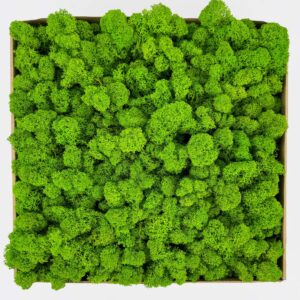
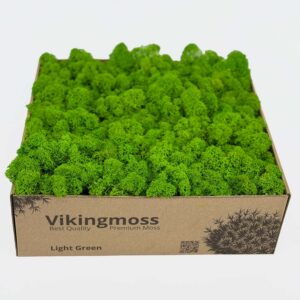
Are you interested in reindeer moss? Check out our stabilized reindeer moss collection and create a unique green decoration that will delight the eye for years without requiring maintenance! Vikingmoss collection of reindeer moss
-

Custom-made reindeer moss walls MUSE Vikingmoss
1600zlotySelect an option This product has multiple variants. You can select your options on the product page -
Vikingmoss™ custom-made moss arrangement
1600zlotySelect an option This product has multiple variants. You can select your options on the product page -
Chrobotek PREMIUM Vikingmoss™ lichen
29zlotySelect options This product has multiple variants. You can select your options on the product page


Summary: Lichen – a fascinating organism with a rich history
Lichen is an organism with a fascinating natural and cultural history. Its origins in the harsh northern regions have given it exceptional resilience and character, making it an ideal material for creating long-lasting decorations.
The etymology of the name "lichen," referring to its distinctive texture and the rich history of its use in northern cultures, add an additional dimension to this lichen. It is not only a decorative element but also a carrier of a fascinating story about nature and human culture.
At Vikingmoss , we are proud to share this knowledge with our customers, offering not only the highest quality product, but also education about its origins and unique properties.
Our experience shows that people who choose reindeer moss decorations appreciate not only its aesthetic value but also its history and ecological significance. Therefore, we make every effort to source reindeer moss sustainably, respecting natural ecosystems.
Stabilized reindeer moss is a perfect example of how modern technology can help preserve natural beauty and introduce it into our interiors in a form that is both practical and environmentally friendly.
We encourage you to explore the possibilities that reindeer moss offers in interior design – from small compositions to impressive green walls that will bring an element of nature to your space for years to come.

Hi, my name is Marian Sikora and I'm the founder of Sikorka and Vikingmoss a company that has been producing wooden world maps for walls and moss walls since 2018. My extensive experience and qualifications have led to my success. I began my career in the IT industry, where I spent many years creating websites, graphic design, programming, and implementing marketing campaigns. However, over time, I desired a change and decided to channel my passion for creation into something more tangible.


