
Ecology, the science that studies the relationships between organisms and their environment, is particularly relevant in the context of interior design. In 2025, as environmental challenges become increasingly pressing, consumers are seeking solutions that combine natural beauty with a responsible approach to the planet's resources. This raises the question: are stabilized plants like moss or eucalyptus truly a sustainable choice?
At Vikingmoss we regularly analyze the environmental impact of our products. Our experience shows that stabilized plants are a sustainable alternative to some traditional decorations, but their environmental friendliness depends on many factors, from the method of sourcing the raw material to the stabilization methods.
Moss and other preserved plants are gaining popularity not only for their aesthetic appeal but also for their potential environmental benefits. In this article, we'll explore the ecological aspects of various types of plants used in interior decoration—from live to dried to preserved.
The origin of moss and other stabilized plants – are they obtained sustainably?
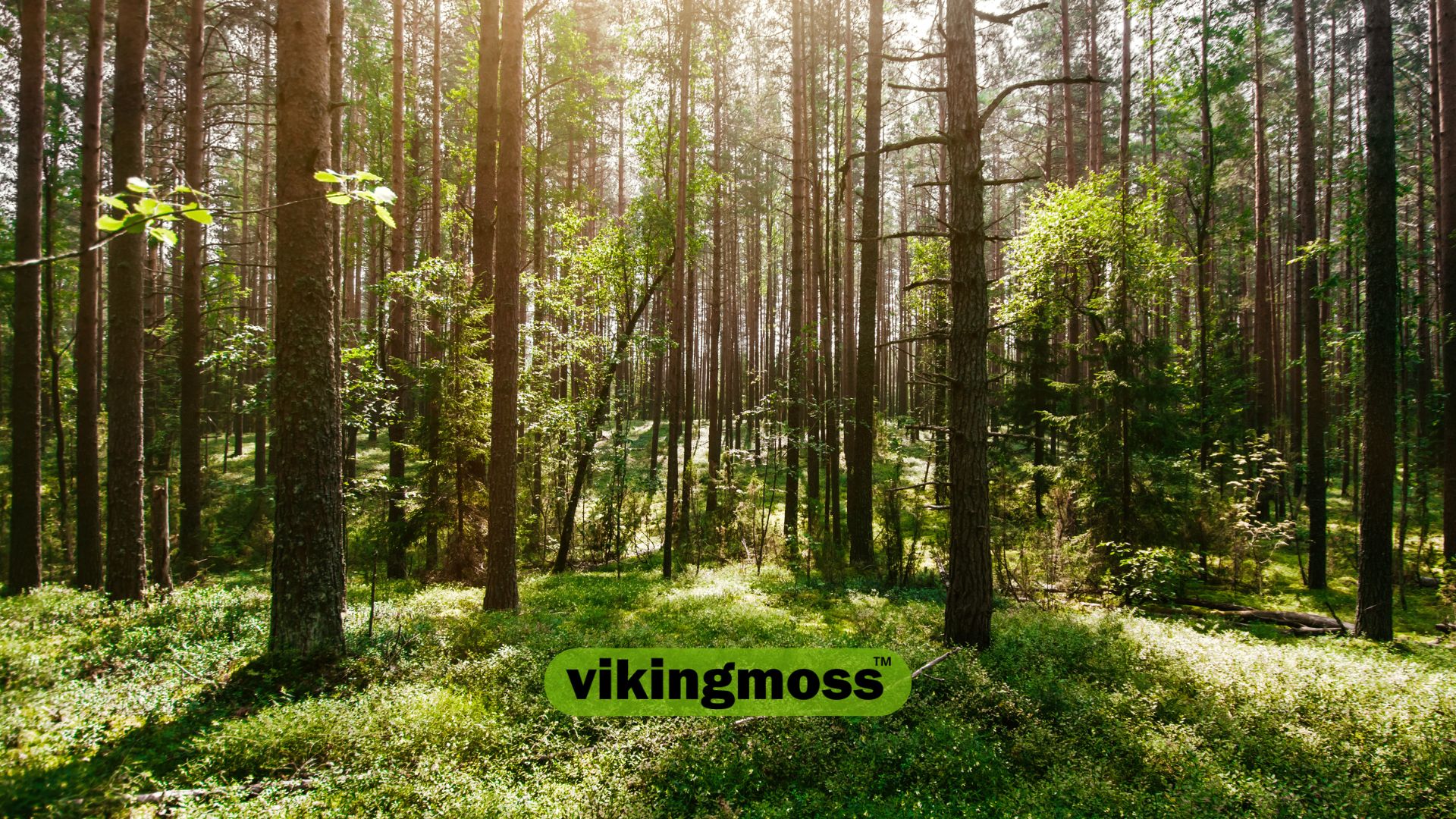
A key ecological aspect of stabilized plants is their method of extraction. Moss used in interior decoration comes primarily from the forests of northern Europe, including Scandinavia, where it occurs in natural forest ecosystems.
Responsible producers like Vikingmossonly work with certified suppliers who harvest their moss in accordance with strict environmental regulations. We practice selective harvesting, always leaving the majority of the natural habitat intact, allowing for natural regeneration.
It is worth emphasizing that all the plants in our offer are obtained legally, in compliance with local nature conservation regulations.
Legal moss harvesting in the light of European regulations
In Europe, moss is subject to legal regulations that vary from country to country. Many moss species are not strictly protected, which allows for their commercial harvesting, but under certain conditions:
- Collection must take place outside protected areas such as national parks or nature reserves.
- Harvesting should be selective and sustainable, allowing for regeneration.
- In some countries, special permits or licenses are required.
Our suppliers adhere to these principles, and we regularly verify their practices. This ensures that the moss used in our products is sourced responsibly and legally.
Comparison of the environmental impact of different types of ornamental plants
To better understand the ecological dimension of different types of plant decorations, it is worth comparing their impact on the environment:
| Type of decoration | Impact on biodiversity | Resource consumption during production | Transport carbon footprint | Durability |
| Live plants | Low (commercial crops) | High (water, fertilizers, pesticides) | Repeatable (regular deliveries) | Low (replace every few months) |
| Dried plants | Medium (one-time collection) | Low (drying process) | Disposable | Medium (2-3 years) |
| Stabilized plants | Medium (one-time collection) | Medium (stabilization process) | Disposable | High (10-15 years) |
| Artificial plants | Feeding | Very high (synthetic materials) | Disposable | Very high (10+ years) |
As the above comparison shows, each option has its ecological advantages and disadvantages. Stabilized plants occupy a middle ground, offering durability similar to synthetic plants, while having a significantly lower environmental impact during production.
The process of plant stabilization and ecology – is stabilization ecological?
The stabilization process is a key element that determines the ecological nature of the final products. At Vikingmoss we use a method that replaces natural plant juices with a blend of plant-based preservatives.
Traditionally, plant stabilization involves the use of glycerin and dyes. Our company has developed improved methods that minimize the use of chemicals and maximize the use of natural ingredients.
Although this process is not completely environmentally friendly, the substances we use are biodegradable and do not contain harmful compounds.
Is stabilized moss biodegradable?
One of the most common questions about the environmental friendliness of stabilized moss is its biodegradability. Stabilized moss is fully biodegradable , although it takes longer to decompose than fresh moss.
Under favorable conditions, stabilized moss decomposes naturally within 2-3 years after use. This is significantly better than artificial plants made of plastic, which can take hundreds of years to decompose.
Importantly, the biodegradability of stabilized moss means that after its use, it does not contribute to the problem of plastic littering, which is a huge advantage from an ecological point of view.
The impact of stabilized plants on air quality – myth or reality?
We're often asked whether moss and other stabilized plants improve indoor air quality as much as live plants. It's important to be clear: stabilized plants don't have the ability to actively purify the air because they don't photosynthesize.
This doesn't mean, however, that they are completely devoid of a positive impact on air quality. Our research shows that stabilized moss has hygroscopic – it can absorb excess moisture from the air and release it when the air is too dry, acting as a natural humidity regulator.
Additionally, the moss surface acts as a natural mechanical filter, trapping dust particles and other airborne pollutants. While this process isn't as intensive as with specialized air filters, it provides an additional benefit for users.
Comparison of the cleansing properties of different types of plants
| Type of plant | CO₂ absorption capacity | Oxygen production | Filtering contaminants | Humidity regulation |
| Live plants | High | High | Medium to high | Mean |
| Dried plants | Lack | Lack | Low | Low |
| Stabilized plants | Lack | Lack | Low to medium | Mean |
As you can see, stabilized plants cannot compete with live plants in terms of active air purification. However, in spaces where maintaining live plants is problematic, they are a much better alternative to artificial plastic plants, which offer no air quality benefits.
Ecological balance – is it worth choosing stabilized plants?
When making an ecological assessment of stabilized plants, the entire life cycle of the product should be taken into account – from raw material acquisition, through the production process, transport, use, and disposal.
At Vikingmoss we have conducted a comprehensive analysis of the carbon footprint of our products, which has shown that, over a 5-year period, stabilized plants generate a significantly lower carbon footprint than regularly replaced live plants in harsh indoor environments.
Here are the key factors that support the environmental friendliness of stabilized plants:
- Long lifespan – products last for many years, eliminating the need for regular replacement.
- No water consumption – unlike living plants, they do not require watering.
- No need to use pesticides and fertilizers – eliminating the release of these substances into the environment.
- Biodegradable – they decompose naturally after use.
- One-time transport – they do not require regular deliveries like live plants.
The most ecological applications of stabilized plants
Our customer experience shows that stabilized plants are the most ecological choice in the following situations:
- In spaces with difficult conditions where living plants would require frequent replacement.
- In places with limited access to natural light, where living plants would require energy-intensive lighting.
- In locations where regular maintenance would be problematic or involve high resource consumption.
- In arrangements requiring a specific, unchanging appearance for a long time.
In such cases, stabilized plants represent a reasonable compromise between the aesthetic appearance of natural elements and environmental concerns.
-
 51zlotySelect options This product has multiple variants. You can select your options on the product page
 -
A round picture made of moss and plants stabilized in a frame
387zlotySelect options This product has multiple variants. You can select your options on the product page -
38zlotySelect options This product has multiple variants. You can select your options on the product page


Ecological care of moss and stabilized plants
One of the most important advantages of organic, stabilized plants is their minimal maintenance. Unlike living plants, they do not require watering, fertilizing, or the use of pesticides.
Proper care of stabilized moss is limited to:
- Occasional vacuuming using compressed air or a soft brush.
- Avoid direct sunlight, which may cause colors to fade.
- Keep in rooms with moderate humidity (40-60%).
This minimalist care translates into zero water consumption and no release of chemicals into the environment during product use.
Unlike artificial plants, which often require cleaning with detergents, stabilized moss can be refreshed without the use of chemicals, further reducing its environmental impact.
Is it possible to extend the life of stabilized moss?
Our company's proven methods show that appropriate storage conditions can significantly extend the life of stabilized moss, maximizing the ecological benefits of its long-term use:
- Maintaining stable air humidity (avoiding extremely dry rooms).
- Protection from intense sunlight, which accelerates fading.
- Avoiding placement near heat sources such as radiators or fireplaces.
By following these rules, you can extend the life of stabilized moss by up to 5-7 years, which further improves its ecological balance.
Responsible use of stabilized plants in commercial projects
Commercial projects, such as hotels , restaurants, and offices , have particular potential to leverage the ecological benefits of preserved plants. In such spaces, maintaining live plants often entails high environmental costs – high water consumption, frequent replacement of plants that cannot cope with harsh conditions, and regular transportation.
Our experience with business clients shows that replacing traditional plant decorations with stabilized moss compositions can bring measurable ecological benefits:
- 100% reduction in water consumption compared to live plants.
- Reducing the carbon footprint associated with transportation.
- Eliminating the need to use pesticides and fertilizers in public spaces.
- Long-term maintenance of aesthetic appearance without regular replacement.
An example of a 10 m² moss installation in a hotel space can save up to 5,000 liters of water per year compared to a similar green wall made of living plants.

Ecological certificates for commercial projects
A growing number of commercial projects are pursuing environmental certifications such as LEED and BREEAM. Stabilized plants can help meet some of the requirements of these certification systems:
- Reduction of water consumption in the building.
- Improving the quality of the indoor environment through natural decorative elements.
- Use of renewable and biodegradable materials.
At Vikingmoss we help our clients document the ecological aspects of our installations, which can be helpful in the building's environmental certification process.
Choose eco-friendly solutions with Vikingmoss
If you're looking for an eco-conscious choice of plant decorations, please contact our experts. At Vikingmoss we combine environmental care with a passion for creating beautiful, natural compositions.
Our advisors will help you choose solutions that best suit your needs and ecological values – from small tabletop arrangements to extensive moss wall installations.
Take a step towards a more sustainable approach to home decor! Visit our website www.vikingmoss.com to see our full range of eco-friendly moss and preserved plant decorations vikingmoss
By choosing Vikingmoss, you can be sure that your decorations not only look beautiful, but have also been created with respect for the natural environment – from responsible sourcing of raw materials to eco-friendly production methods.

Hi, my name is Marian Sikora and I'm the founder of Sikorka and Vikingmoss a company that has been producing wooden world maps for walls and moss walls since 2018. My extensive experience and qualifications have led to my success. I began my career in the IT industry, where I spent many years creating websites, graphic design, programming, and implementing marketing campaigns. However, over time, I desired a change and decided to channel my passion for creation into something more tangible.


